Birth Marks

Treatments Offered

Happy Patients!

Years In Service

Highly Rated Google!
Birth Marks
Birthmarks are the areas of discoloured skin with or without alteration in skin texture formed due to an error in the organisation of skin cells or blood vessels during the time of fetal development.

Birthmarks can appear on any area of the body. Some of them appear above the skin surface, while some form under the skin. Birthmarks occur and are usually apparent at birth or in early childhood (first five years of life). In a few cases, small-sized marks may not be noticeable at birth until they grow more prominent at a later age.
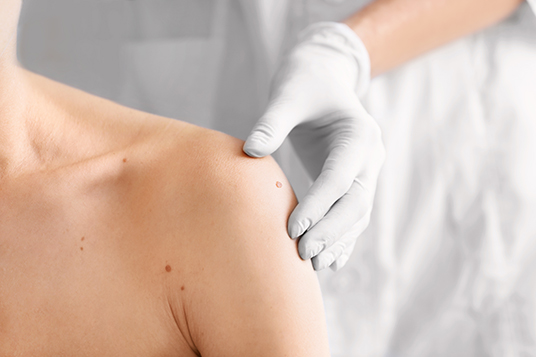
A Full Range of Clinical Services

Beyond Aesthetics Clinic only uses high-end technology ensuring our patients experience the least discomfort and receive the best possible results.
Types & Classification Of Birthmarks:

Naevus flammeus (Port Wine Stains): The medical term for port wine stains (PWS) is naevus flammeus. Most PWS or firemarks affect the face but may involve any area of the skin. They begin as flat, faint red or purple-pink mark at birth. It often turns dark red or purple in adults, and the overlying skin becomes thicker than the surrounding one. Lumps can form, which may bleed readily. Lips or nose if involved may appear swollen. It does not go away on its own. Approximately three in every 1,000 babies (0.3%) have a port wine stain at birth.
Macular stains – Stork bites or angel’s kiss: Medically referred to as Nevus Simplex, is a flat, pink, irregular shaped area of skin. The macular stain or salmon patch is termed as “angel’s kiss” when they appear on the front (forehead, bridge of the nose, eyelids, upper lip), and “stork bites” when they occur on the back (nape of the neck). The prevalence varies from 20-60 %. Majority of the macular stains resolve spontaneously on their own within the first year of age.
Hemangiomas: Hemangiomas are lumpy, reddish-pink bulges on the skin. Some are superficial and appear on the surface of the skin (“strawberry marks”), while others form deeper under the skin surface. More than 50 % affect the head and neck. Usually, they involute with age (90% by nine years). The anatomical location determines the risk of complications, and they may be associated with specific syndromes.
Dermal melanocytoses: Dermal melanocytoses are flat, bluish-grey areas of skin that look like bruises. Depending on the area of the body on which they appear, dermatologists may classify them as Mongolian spots, Nevus of Ota or Nevus of Ito. They occur due to abnormal persistence of pigment cells or melanocytes in the deeper layers of skin.
Congenital melanocytic nevi: Congenital melanocytic nevi (CMN) are flat or raised birthmarks that range from light brown to black and can be of variable shapes and sizes (less than 1.5cm to more than 20 cm). Some nevi even have hair growing out of them. 1 in 100 people (1%) has one or more CMN at birth. Usually, they become paler in the first or second year of age, but in a few cases, they may indicate specific syndromes.
Café-au-lait spots: Cafe-au-lait macules (CALM) are tan or light brown flat spots that are usually oval. Their incidence varies with race (0.3%-18%). Six or more such spots may be a sign of neurofibromatosis.